

Not long ago, a real estate developer retained us to build a brand campaign for a new home community. This placemaking project was really special, highly differentiated, and a new venture for them. Their ask was simple at face value: create awareness and drive interest list demand. They already had a name, a visual identity, and a strong environmental identity. What they needed, they figured, was a campaign.
Once we got into the work, we realized they needed something else first.
The brand had all the right assets but was missing an animating idea. The core belief that all campaign creative could ladder up to. Without that, any creative we built would be a one-off. It might generate awareness, but it wouldn’t build meaning that compounds over time. We weren’t being asked to run a campaign; we were being asked to launch a brand. And that required a platform.
It’s a distinction that comes up frequently in our world, and one that’s genuinely underappreciated and often misunderstood outside of brand and creative circles. Here’s our stab at demystifying it.
So what is a brand platform, exactly?
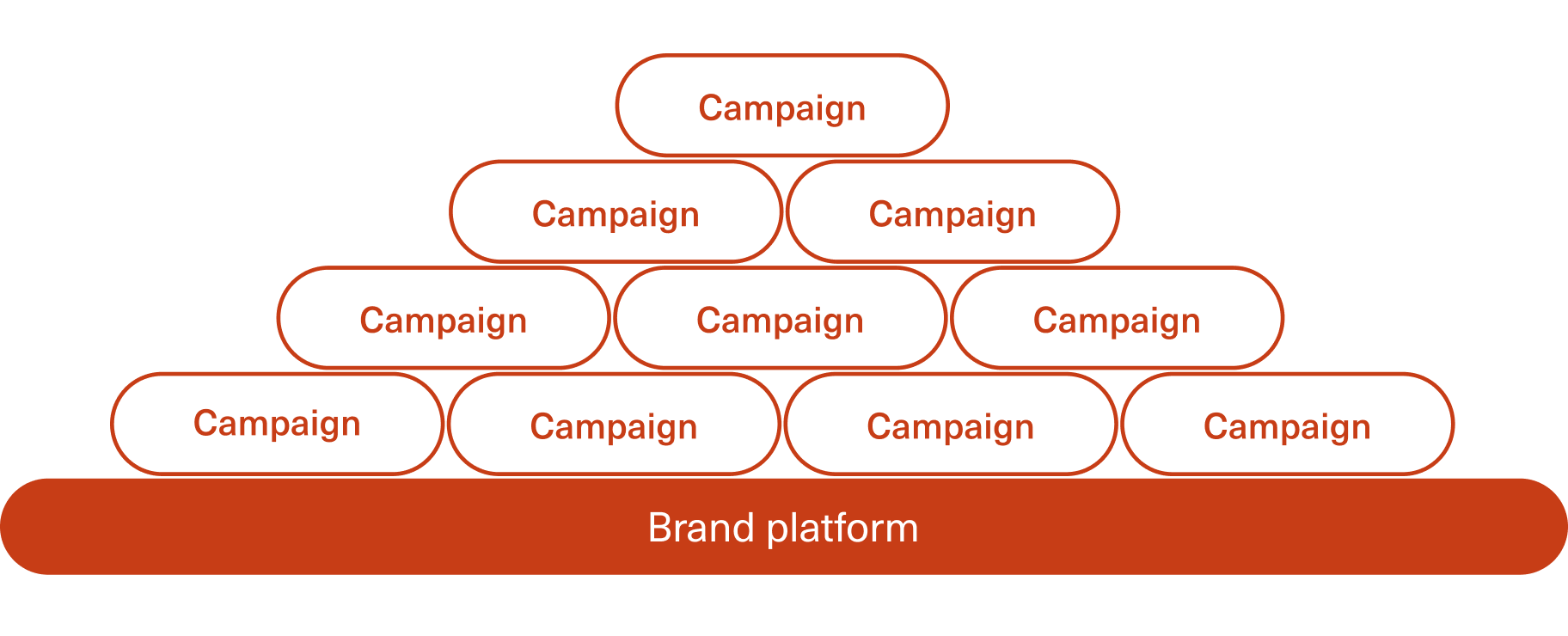
A brand platform is a single, central idea that a brand stands for—expressed in a way that’s inspiring enough to generate creative work, durable enough to last several years, and flexible enough to show up across every channel and every campaign.
It’s not a tagline. It’s not a campaign. It’s not a slogan, though it will inform all of those things. Think of it as the creative and strategic foundation everything else is built on. When it’s working, a platform gives a brand distinct coherence. When it’s absent, that coherence drifts. With our client, we could feel it: great name, strong visual identity, but ask what the brand truly stood for, what feeling it was trying to create, what belief it was asking people to share—and the answer wasn’t there yet.
A platform is typically expressed through a combination of: a brand positioning, a core brand idea or creative territory, a defined voice and tone, visual identity principles, and key messages. Together, these form a system that lets a brand show up consistently and evolve without losing itself.
When does a company need one?
Three scenarios tend to trigger platform work.
The first is a launch. When a brand is entering the market for the first time, it has a narrow window to claim a position and create a feeling before the space gets defined for them. That was our situation. The community was new, the developer was new to the category, and the first impression would be the lasting one.

The second is drift. Brands that have been around for a while can lose their strategic center through growth, diversification, or just plain time. The equity might still be there, people recognize the name, but the “big idea” is dormant or gone altogether. A good recent example is Kotex, a brand that’s been around for over a century and a pioneer in the period care category. But by its own leadership’s admission, it had been “losing relevance” with customers for years. In early 2026, they launched a new global brand platform called “Own Your Flow”—built on the belief that young women face enormous external pressures to conform, and that a period care brand has a genuine role in pushing back. That idea gave everything else direction.
The third trigger is relevance. When the market has shifted, new competitors have entered, or the cultural context has changed, a platform built for a different era may no longer hold up.
It’s not a campaign—even a big one
This is the distinction that trips people up most.
A campaign is built to solve a specific brief. It has an objective, an audience, and a timeline. When it does its job, it’s done. A platform is the idea that lets multiple campaigns, across multiple briefs and multiple years, feel like they came from the same brand.
The Kotex launch is a great example. “Own Your Flow” debuted with a 90-second cinematic anthem film using tennis as a metaphor for the scrutiny young women face—a straight-forward brand play. But the brand also launched “You Asked. We Heard.,” a product campaign to support its pad reformulation, with a spot featuring women in bathroom stalls voicing relatable complaints until someone passes a redesigned pad under the divider. Different brief. Different creative hook. Same brand. Same empowerment idea. That’s a platform at work.
For our developer client, the implication was direct: the campaign to build awareness and early interest needed to be an expression of a platform, or it would be a dead end. It would generate leads, but it wouldn’t build the brand equity that supports a years-long sales cycle or create a community identity that makes people want to live there.
It’s not a rebrand, and it’s not a slogan
Two common points of confusion come up. Let’s address those quickly.
A rebrand changes fundamental identity markers—name, logo, color system, voice and tone. A platform is a new idea, and it can be built on top of existing brand infrastructure, provided those elements still hold valuable equity.
Our client didn’t need to change their name or visual identity. They needed a core idea that made those assets mean something. Kotex made some visual updates alongside “Own Your Flow,” including a new core color and refreshed typography, but that was in service of the platform, not a rebrand.
A slogan is a deliverable. A platform is the system the slogan comes from. “Own Your Flow” functions as both—a creative phrase that also sums up the full belief system. Sometimes this happens, and when it does that’s great.
The point is that if you strip away the platform the anthem film feels like a one-off, the product campaign feels unrelated, and the visual updates are arbitrary. The platform is what makes all the sum of the parts greater.
It’s your big bet
A brand platform is the big creative bet you’re making on behalf of a brand—a commitment to a direction you’re willing to live with long enough for it to compound into real recognition and trust.
We went back to our developer client and reframed the engagement. Before we could build a campaign, we needed to build a platform. They agreed, and that shift unlocked all the creative work that followed.
At Truss, we describe what we do as storytelling, elevated. That means something specific to us: before we make anything, we start with the essence of a brand, its place in the world, the way it exists in genuine dialogue with the people it’s trying to reach. A brand platform is where that work begins. It’s the difference between creative that looks good and creative that means something.
If your campaigns feel disconnected, if every brief feels like it’s starting from scratch, if the work isn’t adding up to something larger—there’s almost certainly a platform gap. Building one isn’t about starting over. It’s about finding the idea that’s already embedded in who your brand is today, and finding the creative courage to tell that story. If you’re thinking about a platform, a launch, or a refresh, we’d like to hear from you.